
Yamas and NiYamas
May 18, 2026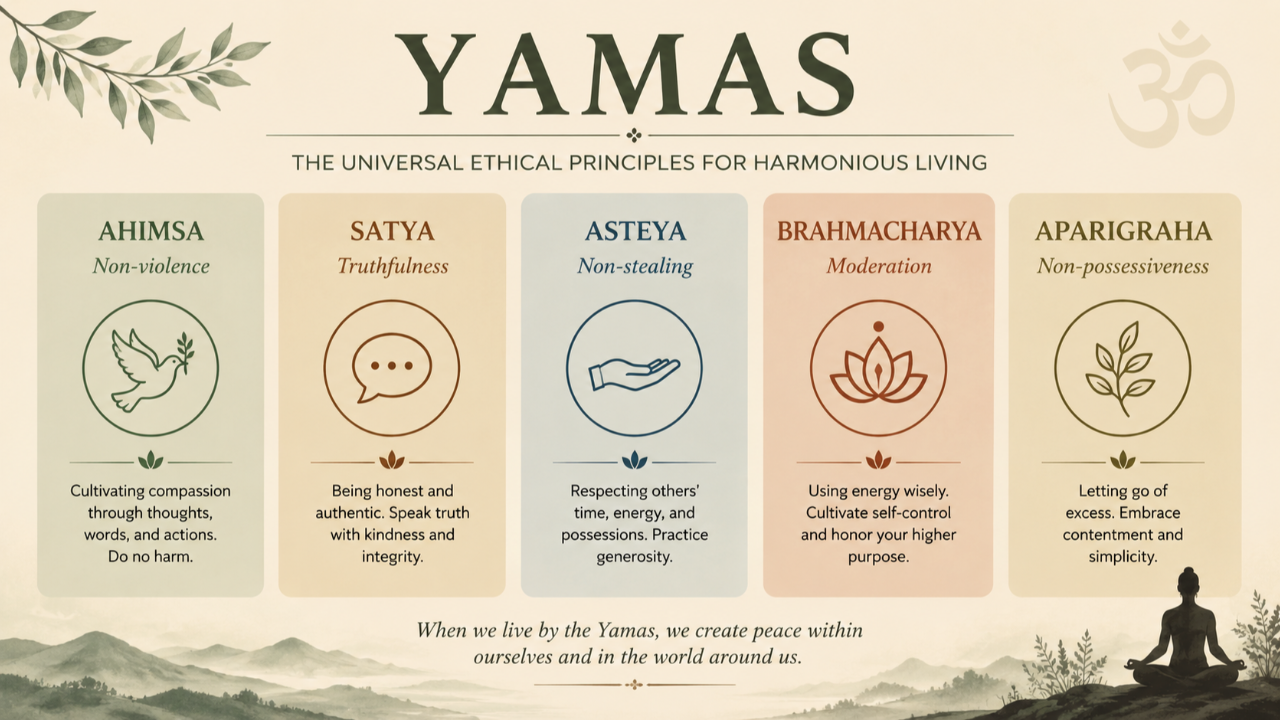
The Yamas: Expanding the Foundations of Conscious Relationship
In Yoga philosophy, the Yamas are often described as ethical guidelines — but that framing can sometimes make them feel rigid, moralistic, or abstract.
Another way to approach them is as relational capacities.
They are practices that help us expand our ability to:
- remain connected under stress,
- reduce unnecessary suffering,
- increase clarity,
- deepen mutuality,
- and relate to ourselves and others with greater consciousness.
The Yamas are not simply rules to obey.
They are invitations into more skillful ways of being.
The Five Yamas
1. Ahimsa — Non-Harming
Ahimsa is often translated as non-violence, but it includes far more than physical harm.
It asks us to notice:
- the tone of our thoughts,
- the impact of our words,
- the emotional atmosphere we create,
- and the subtle ways reactivity spreads suffering.
Ahimsa does not mean passivity or lack of boundaries.
It means reducing unnecessary harm while remaining truthful and conscious.
In modern relational life, Ahimsa may include:
- pausing before reacting,
- regulating activation,
- listening more carefully,
- and learning how to disagree without dehumanizing.
2. Satya — Truthfulness
Satya is the practice of truthfulness.
But truthfulness is not merely factual accuracy.
It also includes authenticity, congruence, and emotional honesty.
Many people can state facts while remaining profoundly disconnected from themselves.
Satya invites us to ask:
- What am I actually feeling?
- What am I avoiding?
- What story am I constructing?
- What becomes possible when truth and compassion coexist?
Truth without Ahimsa can become brutality.
Ahimsa without Satya can become avoidance.
The two are deeply braided together.
3. Asteya — Non-Stealing
Asteya traditionally means non-stealing, but the concept extends beyond possessions.
We can also steal:
- attention,
- emotional labor,
- time,
- trust,
- presence,
- or opportunities for mutuality.
Asteya invites us to develop respect for the inner world and resources of others.
It also asks us to notice scarcity thinking:
- grasping for validation,
- needing excessive control,
- or taking from relationships without reciprocal contribution.
In this sense, Asteya becomes a practice of integrity and reciprocity.
4. Brahmacharya — Wise Use of Energy
Historically interpreted in various ways, Brahmacharya can be understood as conscious relationship with energy and attention.
Where does our energy go?
What consumes our mind?
What repeatedly dysregulates us?
What actually nourishes us?
In contemporary life, Brahmacharya may involve:
- reducing compulsive overstimulation,
- noticing addictive patterns,
- balancing solitude and connection,
- and learning how to sustain attention intentionally.
It is less about repression and more about alignment.
5. Aparigraha — Non-Grasping
Aparigraha invites us to loosen the grip of clinging.
We grasp at:
- identities,
- certainty,
- resentment,
- control,
- status,
- narratives,
- and imagined futures.
Much suffering emerges not simply from pain itself, but from the mind’s refusal to release.
Non-grasping does not mean disengagement from life.
It means learning how to participate deeply without compulsively attaching to outcomes.
Paradoxically, this often creates greater peace, flexibility, and intimacy.
The Yamas as Relational Development
The Yamas become especially powerful when viewed not as commandments, but as developmental practices.
They help expand:
- metacognitive awareness,
- emotional intelligence,
- self-regulation,
- empathy,
- repair capacity,
- and conscious relationship.
Rather than asking:
“Am I a good person?”
The Yamas invite a different question:
“What capacities am I developing?”
This shifts the framework from shame toward growth.
And perhaps that is part of why these teachings continue to resonate thousands of years later:
they remain profoundly practical descriptions of how human beings reduce suffering and deepen connection — both internally and interpersonally.
SUBSCRIBE FOR WEEKLY LIFE LESSONS
Lorem ipsum dolor sit amet, metus at rhoncus dapibus, habitasse vitae cubilia odio sed.
We hate SPAM. We will never sell your information, for any reason.